What Is Ladyboy Chat? Meaning, Messaging, and Safety
“Ladyboy chat” usually refers to online messaging and conversation between men and feminine-presenting transgender women—often in Southeast Asian contexts—where the goal is to get to know each other and see if there’s real relationship potential.
People search this topic because the words can be confusing, the etiquette isn’t always obvious, and many daters want to communicate respectfully without turning a person into a label. If you’re here for serious dating, a good chat isn’t about perfect lines—it’s about clarity, warmth, and patience.
If you’re exploring this topic in a relationship-minded way, MyLadyboyCupid is one place where conversations are designed to help people connect more intentionally, not just collect matches.
Ladyboy Chat in Practice: What the Term Usually Means
In practice, “ladyboy chat” often overlaps with phrases like ladyboy dating chat, chat with ladyboys, and transgender dating chat. Sometimes it’s used by people who are specifically looking for Asian trans women, and sometimes it’s used as a general shorthand for messaging on a ladyboy dating site.
Chat is the bridge
The important point is that the word “chat” isn’t a separate category of relationship. It’s the bridge. It’s how you show you’re a thoughtful person—someone who can communicate with kindness, set expectations early, and keep the conversation human rather than transactional.
Intent matters
When men say they want “ladyboy chat,” what they often mean is: “I want to meet someone I’m genuinely attracted to, and I want to talk in a way that leads to something real.” That’s a good intention. The rest is learning how to express it respectfully.
Historical and cultural context
The word “ladyboy” appears online because it’s widely used in some Southeast Asian settings and has been repeated in English-language media for years. In Thailand, you may also see local terminology like “kathoey” used in everyday conversation, while in the Philippines people may use different local phrasing or simply identify as trans women.
Online search behavior also shapes language: certain keywords become common because people type them into Google—even when the most respectful day-to-day language is simply “trans woman” or “transgender woman.” Knowing that difference helps your messaging sound modern and considerate.
For a relationship-focused approach, treat “ladyboy” as a context term, not a default label. When someone shares how she describes herself, that’s the language to follow.
Respectful Words That Keep Things Warm
It’s common for “ladyboy” to overlap with transgender identity, but it doesn’t map perfectly to one identity everywhere. Some women are comfortable with the term, some aren’t, and some prefer “trans woman” or “transgender woman” because it centers identity rather than a category.
The easiest rule is simple: ask once if you’re unsure, then mirror her preference and move on. That one habit instantly makes your chat feel safer, calmer, and more relationship-ready.
| Term | What it usually signals | Best practice |
|---|---|---|
| Ladyboy | Cultural shorthand; feminine presentation; often linked to Southeast Asian contexts. | Use when self-identified or when discussing the word itself; avoid as a default label. |
| Trans woman | Gender identity term; a woman who is transgender. | Generally safe umbrella language; still follow personal preference. |
| Transgender woman | More formal identity term; common in educational content. | Good for clarity in articles; keep tone respectful and human. |
| Local cultural terms | Community-specific language that may carry nuance outsiders miss. | Use carefully, preferably when someone uses it for herself or within explained context. |
| Shemale | An outdated term historically associated with adult content and objectification rather than identity. | Best avoided. Many people find it demeaning or fetishizing; use respectful identity-based language instead. |
| Transsexual | A medicalized term focused on physical transition, more common in older clinical or legal contexts. | Generally avoid in casual conversation; prefer “trans woman” or follow the language a person uses for herself. |
A gentle mindset shift
If your message sounds like you’re trying to classify someone, it will feel cold. If your message sounds like you’re trying to know her—her day, her values, her pace—it will feel romantic in a grounded way.
Common Misunderstandings
When you drop assumptions, the chat becomes simpler: you’re two adults seeing if your lives and hearts fit. That’s the energy that turns “ladyboy chat” into real connection.
- Myth: One word tells you everything. A keyword never replaces a person’s self-description, boundaries, or relationship goals.
- Myth: “Ladyboy dating” means casual. Many women want serious relationships; intent has to be discussed, not assumed.
- Myth: You must ask private questions early. Curiosity is normal, but timing matters—trust comes before intimate topics.
- Myth: Strong attraction is an excuse for blunt messages. The more you like someone, the more care your words should carry.
- Myth: Online chat is “just chat.” Messaging sets the tone for respect, safety, and whether a meeting will feel comfortable.
6 Truths That Prevent Misunderstandings
These quick points help you avoid stereotypes, communicate respectfully, and keep conversations focused on real compatibility.
Not one identity
“Ladyboy” can overlap with trans women, third-gender identities, or personal labels. You can’t know someone’s identity from a keyword—only from how she describes herself.
No anatomy assumptions
Bodies vary and details are private. Respectful dating focuses on consent and compatibility, not speculation, “tests,” or invasive questions.
Culture shapes meaning
In some places the term is common; elsewhere it may feel outdated or objectifying. Context matters as much as vocabulary.
Respect beats labels
Ask what wording she prefers, listen, and mirror it. That small habit prevents most misunderstandings and keeps the tone human.
Intent varies
Some want serious relationships; others prefer casual dating. Clarify pace and goals early so nobody wastes time or feels pressured.
Privacy is normal
Many people protect privacy online. Patience and consistency build trust faster than pushing for proof, fast disclosure, or personal details.
These points may look basic, but they prevent most misunderstandings—and set a healthier tone for real connection.
If you’re here because you want to date respectfully, treat this as a simple checklist for empathy. You don’t need perfect wording—you need consistent behavior that makes her feel seen, not studied.

Ladyboy Chat on Mobile: Smooth, Private, and Easy
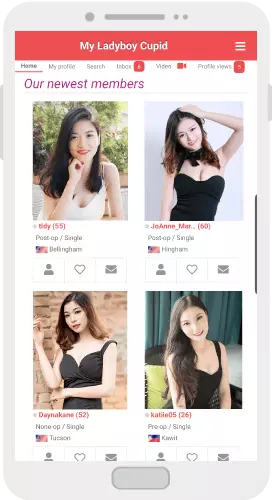
MyLadyboyCupid is fully mobile-friendly, so you can browse profiles, send messages, and keep conversations flowing directly from your phone or tablet—without downloading an app. The interface is designed for fast, comfortable chatting on smaller screens, making it easier to reply on the go, stay consistent, and build real connection through respectful messaging. Whether you’re starting a first conversation or continuing something meaningful, MyLadyboyCupid keeps ladyboy chat simple, accessible, and relationship-focused.
A Chatting Framework That Feels Natural (Not Scripted)
Good dating chat etiquette has one quiet goal: make it easy for both people to relax. When the tone is calm, romantic conversation becomes possible—especially when you’re talking across cultures, time zones, and different comfort levels around disclosure.
Start with respectful specifics. If you compliment, keep it human: her smile, her style, a detail in her profile that shows personality. Then add one open-ended question that invites a real answer. That combination—warmth plus curiosity—builds momentum without pressure.
When your intention is a serious relationship, say it early without demanding agreement. You’re not asking her to commit in a chat box; you’re letting her know the direction you’re walking. That’s what makes a ladyboy dating chat feel safe rather than chaotic.
Less swiping, more conversation.
How to keep the flow
- Balance questions with small self-disclosure so it feels like a dialogue, not an interview.
- Let her set pacing; fast replies are nice, but patience is more romantic than pressure.
- Use short paragraphs; long blocks can feel heavy in early chat.
- When you disagree or misunderstand, clarify gently rather than debating identity or “definitions.”
When you’re ready to move from chat to a plan, keep it simple and time-boxed: a short coffee or an early evening walk. The goal is not to “prove” anything—it’s to see whether the conversation feels even better face-to-face.
How Serious Intent Shows Up
On any ladyboy dating site, people quickly learn to spot who is genuinely ready for a relationship and who is only chasing fantasy. The difference is rarely about perfect photos. It’s about consistency: your words, your patience, and whether your questions show real interest in a person’s life.
Green flags in chat
- Clear intentions without pressure or ultimatums.
- Polite curiosity about her day, goals, and preferences.
- Comfort with normal pacing and boundaries.
- Consistent tone over time (not hot-and-cold messaging).
- Respectful language that mirrors her self-description.
Red flags to notice early
- Sexual questions in the first messages or repeated boundary-pushing.
- Trying to “test” identity or demanding private details.
- Rushed requests to move off-platform immediately.
- Anger when you don’t reply instantly.
- Insults, stereotypes, or fetish language.
When you focus on authenticity—how someone behaves, how consistent the story feels, whether the chat is respectful—you reduce guesswork and protect your time. That’s what most people mean when they search for “chat with ladyboys” and hope it won’t feel messy or confusing.
The Romantic Part Is the Respect
The sweetest part of ladyboy dating is the same as any other relationship: being chosen for who you are, not for a category. A serious connection grows when both people feel safe to be real—messy days, small joys, long-term hopes, and honest boundaries.
If you want a relationship, treat “chemistry” as something you build, not something you demand. Consistent kindness is surprisingly attractive, especially in online dating where many people have learned to expect the opposite.
For a first meeting, choose a public place, keep it time-boxed, use your own transport, and tell a friend where you’re going.
When you meet with that calm approach, the date becomes lighter. You’re not trying to rush intimacy—you’re creating a space where attraction can breathe, and where real affection has room to grow.
Modern Usage and Etiquette: What Not to Ask Too Early
Romantic interest is welcome. Interrogation is not. Early chat should feel like two people discovering compatibility—values, pace, and the everyday details that make a relationship possible.
- Anything about anatomy or surgery.
- Questions that demand “proof” of identity or photos for verification.
- Requests for explicit content or sexual details.
- Personal documents, legal names, or private information.
- “Are you real?” framed as an accusation instead of normal curiosity.
If you’re worried about authenticity, focus on normal signals: consistent conversation, coherent details, and comfort with a simple, respectful video call later if both people want that. The more you treat her like a whole person, the more likely the chat becomes romantic instead of tense.
Where Ladyboys Are Commonly Seen in Thailand
In Thailand, visibility of feminine-presenting transgender women can be higher than many Western visitors expect, partly because the culture has long had public language and social awareness around gender diversity. You may see trans women and people who use the word “ladyboy” in everyday settings connected to customer-facing work, online communities, and the broader entertainment industry at a high level.
In larger cities such as Bangkok, you might notice that people are more used to difference and more comfortable with a wide range of gender expression in public life. The same visibility can appear in tourist-facing areas like Pattaya or Phuket, where many international visitors already expect diversity and where people work in many kinds of public roles.
Online, Thailand is also a common reference point because search terms like “ladyboy dating Thailand” and “kathoey dating” appear frequently in English-language browsing, even when individual women simply identify as women and prefer neutral language in conversation.
Social Visibility of Ladyboys in the Philippines
In the Philippines, many transgender women are visible in everyday community life, especially in service-oriented roles and social spaces where people interact naturally across different backgrounds. As in many places, individual comfort with labels varies, and you’ll often find that “trans woman” is preferred in direct conversation while “ladyboy” may show up more in online search behavior.
Manila is sometimes mentioned as an example of a place where diverse communities are more visible because it’s a large, modern capital with active social networks and online dating culture. Cebu may also be referenced for similar reasons—people are connected, mobile, and used to meeting across distance through apps and dating platforms.
For relationship-minded dating, the most important takeaway isn’t which keyword is common. It’s that many women value privacy and pacing, and respectful messaging—especially in a transgender dating context—tends to be the deciding factor in whether a chat becomes a genuine relationship.
Key Takeaways for Ladyboy Chat
- “Ladyboy chat” is just dating conversation—make it warm, respectful, and relationship-forward.
- Mirror the language a woman uses for herself; ask once if you’re unsure, then move on.
- Avoid outdated terms like “shemale” and “transsexual” in most modern dating contexts.
- Good messaging shows intent without pressure and keeps private topics for later, if they’re ever relevant.
- Less swiping and more conversation creates calmer, more romantic connections.
- Safety and pacing matter: keep first meets public, short, and respectful.
If your goal is serious relationships, the best “strategy” is simple: consistent respect, clear intentions, and patience that makes trust feel natural.